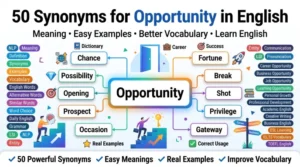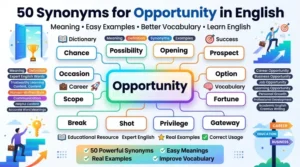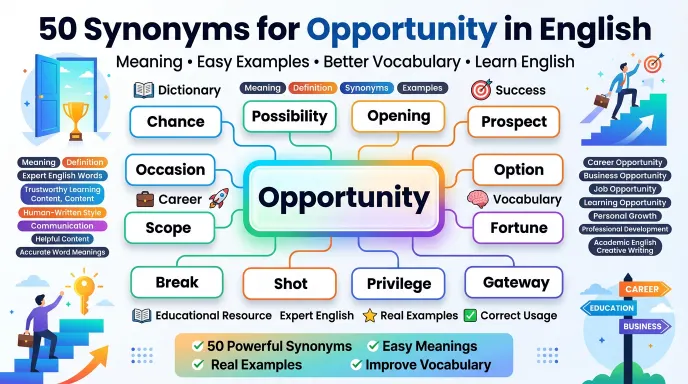
Opportunity has many useful synonyms, including chance, possibility, opening, occasion, prospect, option, break, avenue, gateway, and shot. Each synonym fits different situations, from everyday conversations to formal writing.
Learning synonyms for opportunity helps you express ideas more clearly and avoid repeating the same word. Choosing the right alternative can make your writing more engaging, accurate, and natural.
Some synonyms are ideal for business, education, or professional communication, while others are commonly used in daily English.
In this guide, you’ll discover a complete list of synonyms for opportunity, along with their meanings, example sentences, and practical tips to help you use each word correctly and confidently.
Quick Answer
Synonyms for “opportunity” include chance, occasion, possibility, prospect, opening, break, and window.
Some are casual (break, shot), some are formal (prospect, juncture), and some suggest a narrow or difficult chance (loophole, toehold).
Quick Reference Table
| Keyword | Part of Speech | Meaning | Tone |
| Opportunity | Noun | A favorable chance or time to do something | Positive / Neutral |
Meaning of Opportunity
Definition
According to Cambridge Dictionary, an opportunity is a situation that makes it possible to do something you want to do, or a chance for progress or advancement.
Examples
- Moving to the city gave her a great opportunity to start her career.
- He didn’t want to miss the opportunity to travel abroad.
Connotative Meaning
Connotation is the feeling or idea a word suggests, beyond its dictionary meaning.
- Positive: “Opportunity” usually feels hopeful, exciting, and full of promise.
- Negative: Rarely negative, though “opportunist” (someone who takes advantage unfairly) carries a critical tone.
- Neutral: In business or academic writing, “opportunity” can simply describe a possible option, without emotional weight.
Pronunciation
- US IPA: /ˌɑː.pərˈtuː.nə.ti/
- UK IPA: /ˌɒp.əˈtʃuː.nə.ti/
- Syllables: 5 (op por tu ni ty)
Etymology
The word comes from Latin opportunitas, formed from ob (“toward”) and portus (“harbor” or “port”). It originally described a favorable wind that carried a ship safely into port.
- Old English: No direct form existed; the concept was expressed with words like tima (“time”) or stund (“occasion”).
- Middle English: Borrowed from Old French opportunité, meaning a fitting or convenient time.
- Modern English: opportunity any favorable chance or set of circumstances for doing something.
Word Formation
- Root: portus (Latin, “harbor”)
- Prefix: ob (“toward”)
- Suffix: ity (forms an abstract noun)
- Derived Words:
- Opportune (adjective)
- Opportunist (noun)
- Opportunistic (adjective)
- Opportunism (noun)
30 Synonyms of Opportunity
1. Chance (Noun)
- US IPA: /tʃæns/
- UK IPA: /tʃɑːns/
- Meaning: A possibility or occasion to do something.
- Usage Label: Everyday English
- Frequency: ★★★★★
- Examples:
- This is your chance to prove yourself.
- She took a chance and applied for the job.
2. Occasion (Noun)
- US IPA: /əˈkeɪ.ʒən/
- UK IPA: /əˈkeɪ.ʒən/
- Meaning: A particular time when something happens, especially a suitable one.
- Usage Label: Formal / Neutral
- Frequency: ★★★
- Examples:
- The trip gave him an occasion to reconnect with old friends.
- There was never a good occasion to bring it up.
3. Possibility (Noun)
- US IPA: /ˌpɒs.əˈbɪl.ə.ti/
- UK IPA: /ˌpɒs.əˈbɪl.ə.ti/
- Meaning: A chance that something may happen or be done.
- Usage Label: Neutral / Academic
- Frequency: ★★★★
- Examples:
- There’s a real possibility of getting promoted this year.
- She explored every possibility before deciding.
4. Prospect (Noun)
- US IPA: /ˈprɒs.pɛkt/
- UK IPA: /ˈprɒs.pɛkt/
- Meaning: A chance or possibility for something, especially future success.
- Usage Label: Formal / Business
- Frequency: ★★★
- Examples:
- The new role offers strong career prospects.
- There’s little prospect of the weather improving soon.
5. Opening (Noun)
- US IPA: /ˈoʊ.pə.nɪŋ/
- UK IPA: /ˈəʊ.pə.nɪŋ/
- Meaning: A favorable chance or position that becomes available.
- Usage Label: Everyday English / Business
- Frequency: ★★★★
- Examples:
- There’s an opening for a new manager in our department.
- He waited for an opening to share his idea.
6. Break (Noun)
- US IPA: /breɪk/
- UK IPA: /breɪk/
- Meaning: A stroke of luck that offers a chance for success.
- Usage Label: Informal
- Frequency: ★★★★
- Examples:
- Landing that role was her big break.
- He finally got a break after years of trying.
7. Window (Noun)
- US IPA: /ˈwɪn.doʊ/
- UK IPA: /ˈwɪn.dəʊ/
- Meaning: A limited period of time during which something is possible.
- Usage Label: Everyday English / Business
- Frequency: ★★★
- Examples:
- There’s a small window to submit the application.
- We have a short window before the market changes.
8. Shot (Noun)
- US IPA: /ʃɒt/
- UK IPA: /ʃɒt/
- Meaning: An attempt or chance to achieve something, often used casually.
- Usage Label: Informal
- Frequency: ★★★★
- Examples:
- This is your shot at winning the championship.
- Give it a shot; you have nothing to lose.
9. Scope (Noun)
- US IPA: /skoʊp/
- UK IPA: /skəʊp/
- Meaning: Room or opportunity for something to happen or develop.
- Usage Label: Formal / Academic
- Frequency: ★★★
- Examples:
- There’s scope for improvement in the current plan.
- The role offers scope for creative thinking.
10. Avenue (Noun)
- US IPA: /ˈæv.ə.njuː/
- UK IPA: /ˈæv.ə.njuː/
- Meaning: A possible way of achieving or approaching something.
- Usage Label: Formal
- Frequency: ★★★
- Examples:
- They explored every avenue before giving up.
- This partnership opens new avenues for growth.
11. Platform (Noun)
- US IPA: /ˈplæt.fɔːrm/
- UK IPA: /ˈplæt.fɔːm/
- Meaning: A situation or structure that provides a chance to be seen, heard, or to act.
- Usage Label: Formal / Business
- Frequency: ★★★
- Examples:
- The conference gave her a platform to share her research.
- Social media offers a platform for new artists.
12. Outlet (Noun)
- US IPA: /ˈaʊt.lɛt/
- UK IPA: /ˈaʊt.lɛt/
- Meaning: A means of expressing or using ability, energy, or emotion.
- Usage Label: Neutral / Everyday English
- Frequency: ★★
- Examples:
- Painting became her outlet for creativity.
- The program offers an outlet for young talent.
13. Turn (Noun)
- US IPA: /tɜːrn/
- UK IPA: /tɜːn/
- Meaning: A chance to do or use something, often taken in sequence.
- Usage Label: Everyday English
- Frequency: ★★
- Examples:
- It’s your turn to present the project.
- She waited patiently for her turn to speak.
14. Juncture (Noun)
- US IPA: /ˈdʒʌŋk.tʃər/
- UK IPA: /ˈdʒʌŋk.tʃə/
- Meaning: A particular point in time, often critical or decisive.
- Usage Label: Formal / Literary
- Frequency: ★
- Examples:
- At this juncture, the company must decide its future direction.
- It was a critical juncture in her career.
15. Circumstance (Noun)
- US IPA: /ˈsɜːr.kəm.stæns/
- UK IPA: /ˈsɜː.kəm.stɑːns/
- Meaning: A condition or fact that creates a chance or situation.
- Usage Label: Formal / Neutral
- Frequency: ★★
- Examples:
- Circumstance brought them together at the right time.
- Under different circumstances, she might have accepted.
16. Moment (Noun)
- US IPA: /ˈmoʊ.mənt/
- UK IPA: /ˈməʊ.mənt/
- Meaning: A brief but important point in time when something can happen.
- Usage Label: Everyday English
- Frequency: ★★★
- Examples:
- This is her moment to shine.
- He seized the moment and asked for the promotion.
17. Vantage (Noun)
- US IPA: /ˈvæn.tɪdʒ/
- UK IPA: /ˈvɑːn.tɪdʒ/
- Meaning: A position that gives an advantage or favorable chance.
- Usage Label: Formal / Literary
- Frequency: ★
- Examples:
- The new role gave him a vantage few employees ever get.
- From this vantage, she could see every possibility ahead.
18. Loophole (Noun)
- US IPA: /ˈluːp.hoʊl/
- UK IPA: /ˈluːp.həʊl/
- Meaning: A small, often technical chance to avoid a rule or gain an advantage.
- Usage Label: Neutral / Slightly Negative
- Frequency: ★★
- Examples:
- The lawyer found a loophole in the contract.
- Some companies use tax loopholes to reduce payments.
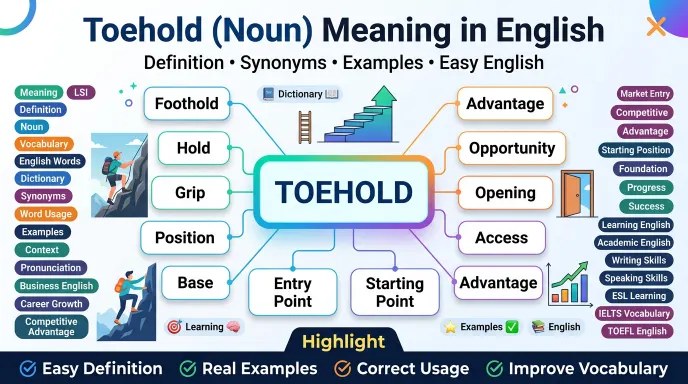
19. Toehold (Noun)
- US IPA: /ˈtoʊ.hoʊld/
- UK IPA: /ˈtəʊ.həʊld/
- Meaning: A small, initial chance to begin achieving something bigger.
- Usage Label: Business / Informal
- Frequency: ★
- Examples:
- The startup finally gained a toehold in the market.
- She used the internship as a toehold into the industry.
20. Foothold (Noun)
- US IPA: /ˈfʊt.hoʊld/
- UK IPA: /ˈfʊt.həʊld/
- Meaning: A secure position that offers a chance to advance further.
- Usage Label: Business / Everyday English
- Frequency: ★★
- Examples:
- The company gained a strong foothold in Asia.
- He worked hard to get a foothold in the film industry.
21. Inroad (Noun)
- US IPA: /ˈɪn.roʊd/
- UK IPA: /ˈɪn.rəʊd/
- Meaning: Progress made into a new area, creating further chances.
- Usage Label: Business / Formal
- Frequency: ★
- Examples:
- The brand made inroads into the European market.
- Scientists have made inroads into understanding the disease.
22. Room (Noun)
- US IPA: /ruːm/
- UK IPA: /ruːm/
- Meaning: Space or scope for something to happen or improve.
- Usage Label: Everyday English
- Frequency: ★★★
- Examples:
- There’s room for growth in this position.
- The plan leaves room for new ideas.
23. Leeway (Noun)
- US IPA: /ˈliː.weɪ/
- UK IPA: /ˈliː.weɪ/
- Meaning: Freedom to act within certain limits, allowing a chance to adjust.
- Usage Label: Informal / Business
- Frequency: ★★
- Examples:
- The manager gave the team some leeway on the deadline.
- There’s little leeway left to change the design now.
24. Latitude (Noun)
- US IPA: /ˈlæt.ɪ.tuːd/
- UK IPA: /ˈlæt.ɪ.tjuːd/
- Meaning: Freedom to choose how to act, creating room for opportunity.
- Usage Label: Formal
- Frequency: ★
- Examples:
- Employees are given latitude to manage their own schedules.
- The judge allowed some latitude in interpreting the law.
25. Fortuity (Noun)
- US IPA: /fɔːrˈtuː.ə.ti/
- UK IPA: /fɔːˈtjuː.ə.ti/
- Meaning: A chance event that happens to bring good fortune.
- Usage Label: Formal / Rare
- Examples:
- It was pure fortuity that led them to meet that day.
- The discovery was more fortuity than planning.
- Frequency: ★
26. Slot (Noun)
- US IPA: /slɒt/
- UK IPA: /slɒt/
- Meaning: An available time, place, or position that offers a chance.
- Usage Label: Informal / Business
- Frequency: ★★★
- Examples:
- There’s an open slot for a new intern this summer.
- She booked the last slot in the schedule.
27. Doorway (Noun)
- US IPA: /ˈdɔːr.weɪ/
- UK IPA: /ˈdɔː.weɪ/
- Meaning: A figurative entry point that leads to a new chance or path.
- Usage Label: Literary / Figurative
- Frequency: ★★
- Examples:
- The scholarship was a doorway to a better future.
- Learning English opened a doorway to new careers.
28. Gateway (Noun)
- US IPA: /ˈɡeɪt.weɪ/
- UK IPA: /ˈɡeɪt.weɪ/
- Meaning: A means or opportunity of access to something.
- Usage Label: Formal / Business
- Frequency: ★★
- Examples:
- The city serves as a gateway to new markets.
- This course is a gateway to a career in data science.
29. Potential (Noun)
- US IPA: /pəˈtɛn.ʃəl/
- UK IPA: /pəˈtɛn.ʃəl/
- Meaning: Existing possibility for future growth or success.
- Usage Label: Formal / Business
- Frequency: ★★★
- Examples:
- Investors saw great potential in the startup.
- The region has untapped potential for tourism.
30. Margin (Noun)
- US IPA: /ˈmɑːr.dʒɪn/
- UK IPA: /ˈmɑː.dʒɪn/
- Meaning: A limited amount of space or room allowed for a chance to act or improve.
- Usage Label: Formal / Business
- Frequency: ★
- Examples:
- There’s little margin for error in this project.
- The tight schedule leaves no margin for delay.
Prototype Meaning
When most people hear “opportunity,” they picture the most typical case: a chance a favorable moment or situation to do something good, often for progress or success. Words like chance, opening, and break sit closest to this core meaning.
Business oriented words like prospect or avenue describe opportunity in a professional context, while words like toehold or foothold describe a small, early stage chance.
Semantic Categories
| Category | Synonyms | When to Use |
| Formal | Occasion, Prospect, Scope, Avenue, Circumstance, Juncture, Vantage, Latitude, Fortuity | Reports, essays, professional writing |
| Informal | Break, Shot, Leeway, Slot | Casual conversation, storytelling |
| Business | Prospect, Platform, Toehold, Foothold, Inroad, Gateway, Potential, Margin | Workplace communication, career writing |
| Everyday English | Chance, Opening, Window, Turn, Moment, Room | General conversation |
| Academic | Possibility, Scope | Research writing, formal analysis |
| Figurative / Literary | Doorway, Gateway, Vantage | Descriptive or creative writing |
Difference Between Similar Words
Opportunity vs. Chance “Opportunity” often implies a planned or meaningful possibility for advancement. “Chance” can be more random or based on luck.
- The scholarship gave her a real opportunity to study abroad.
- By chance, she met her future business partner at the airport.
Opportunity vs. Prospect “Opportunity” describes a specific chance that exists now. “Prospect” often describes a future possibility, not yet certain.
- There’s an opportunity to apply for the role this week.
- The prospect of a promotion motivated him to work harder.
Break vs. Opening “Break” usually implies a lucky or unexpected chance. “Opening” implies a position or space that has become available.
- Getting noticed by that director was her big break.
- There’s an opening for a new team leader.
Loophole vs. Opportunity “Loophole” often has a slightly negative sense a technical gap used to avoid rules. “Opportunity” is neutral or positive.
- He found a loophole to avoid paying the fee.
- She found an opportunity to grow her small business.
Common Mistakes
Mistake: Using “prospect” for a chance that already exists right now. Correct: Use “prospect” for future possibilities, not current ones.
- ❌ There’s a prospect for you to apply today.
- ✅ There’s an opportunity for you to apply today.
Mistake: Using “loophole” as a simple positive synonym for opportunity. Correct: “Loophole” usually implies avoiding a rule, often with a negative or clever tone.
- ❌ The scholarship was a wonderful loophole for her education.
- ✅ The scholarship was a wonderful opportunity for her education.
Mistake: Overusing formal words like “juncture” or “fortuity” in casual writing. Correct: Save rare formal words for academic or professional contexts.
- ❌ I got a fortuity to see my friend this weekend.
- ✅ I got a chance to see my friend this weekend.
Antonyms
| Word | Part of Speech | Meaning |
| Obstacle | Noun | Something that blocks progress or a chance |
| Setback | Noun | A problem that delays or reverses progress |
| Disadvantage | Noun | A condition that puts someone at a lower chance of success |
| Impossibility | Noun | Something that cannot happen |
| Barrier | Noun | Something that prevents access or progress |
Related Words
- Opportune (adjective) happening at a favorable or convenient time
- Opportunist (noun) a person who takes advantage of chances, often unfairly
- Opportunistic (adjective) quick to take advantage of chances
- Opportunism (noun) the practice of seizing chances without regard for principle
Frequently Asked Questions
1. What is the most common synonym for “opportunity”? “Chance” is the most commonly used everyday synonym, while “opening” and “break” are also widely used.
2. What is a formal word for “opportunity”? “Prospect,” “occasion,” and “avenue” are common formal alternatives, often used in business or academic writing.
3. What is a business word for “opportunity”? “Prospect,” “platform,” “foothold,” and “potential” are frequently used in business and career contexts.
4. What’s the difference between “opportunity” and “chance”? “Opportunity” often suggests a meaningful, planned possibility for progress, while “chance” can be more random or luck based.
5. What is a small or early opportunity called? “Toehold” and “foothold” describe a small, early stage chance to grow into something bigger.
6. Can “loophole” mean the same as “opportunity”? Not exactly. “Loophole” usually refers to a technical gap used to avoid a rule, which carries a slightly negative tone.
7. What is a one word synonym for “big opportunity”? “Break” is a common informal one word synonym for a big, lucky opportunity.
8. Why should I use synonyms instead of repeating “opportunity”? Synonyms help you show the exact type of chance you mean planned or lucky, small or large and make your writing sound more natural and precise.
Practice Exercises
A. Fill in the Blanks
- This internship gave her a great _______ to learn new skills. (opportunity / obstacle)
- He found a _______ in the contract to avoid the fee. (loophole / prospect)
- There’s still _______ for improvement in the design. (room / barrier)
B. Multiple Choice
- Which word suggests a future possibility, not yet certain? a) Chance b) Prospect c) Break d) Slot
- Which word describes a small, early chance to grow into something bigger? a) Toehold b) Occasion c) Latitude d) Circumstance
C. Match the Synonyms Match each word on the left with its correct meaning on the right.
| Word | Meaning |
| 1. Window | a) A limited period when something is possible |
| 2. Avenue | b) A possible way of achieving something |
| 3. Vantage | c) A position that gives an advantage |
Conclusion
Learning synonyms for “opportunity” helps you describe chances with more precision and confidence. Instead of repeating the same word, you can choose “prospect” for a future career move, “break” for a lucky turn of events, or “foothold” for an early step into something bigger. This makes your writing clearer and more professional.
Practice using a few new synonyms each week. Try them in cover letters, essays, or daily conversation.
Over time, this small habit will improve your vocabulary, your writing style, and how confidently you speak English.
Which synonym from this list is your favorite? Try using it in a sentence today.
Discover More Articles!
Synonyms for Friend Examples: 30 Easy Words to Use Instead of Friends
Synonyms for Enemy Examples: 50 Powerful Words with Meanings

My name is Sophia Bennett a language researcher and vocabulary writer specializing in synonyms, antonyms, word meanings, and language learning. I creates easy-to-understand educational content that helps readers improve their vocabulary, writing skills, and communication through clear explanations and practical examples.